
Filters
HEPA, True HEPA, H13: what air purifier filter labels really mean
By Theeraphat Chonsiri, Lab Editor5 min read
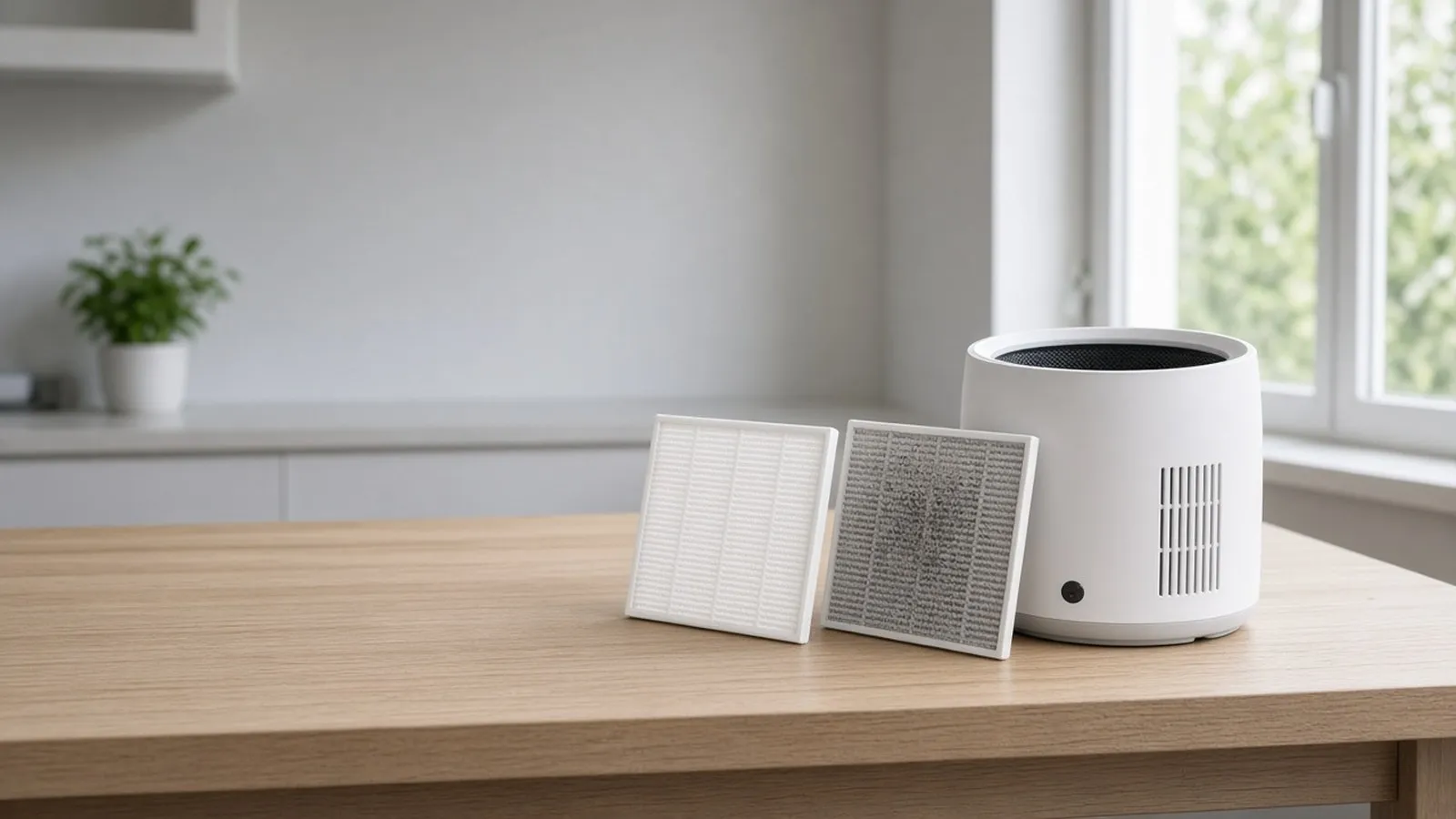
A HEPA filter is a dense mat of fibers that captures at least 99.97% of particles at 0.3 microns under the US standard, or at least 99.95% for an H13 filter under the European standard. Labels like “True HEPA”, “H12” and “H13” describe how efficient the filter is on a single pass. They do not tell you how fast a purifier cleans a room.
This guide explains what each label means, which ones are marketing, and how much weight to give the filter grade when you are choosing a purifier.
What does HEPA stand for?
HEPA stands for High-Efficiency Particulate Air. The term comes from the US Department of Energy, which defines a HEPA filter as one that removes at least 99.97% of particles 0.3 µm in diameter.
The 0.3 µm size is not the smallest particle a HEPA filter catches. It is close to the most penetrating particle size, the size that is hardest to trap. Larger particles hit and stick to the fibers. Much smaller particles bounce around randomly (diffusion) until they touch a fiber. Particles near 0.3 µm fall between those two mechanisms, so a filter that handles them well handles smaller and larger particles even better.
That is why HEPA filters work well on PM2.5, the fine particles from smoke, traffic and haze.
True HEPA vs HEPA-type
“True HEPA” is a marketing term, not a separate standard. Brands use it to signal that a filter meets the 99.97% at 0.3 µm definition.
Watch for close-but-different wording:
- “HEPA-type”, “HEPA-like”, “HEPA-style”: usually means the filter does not meet the HEPA standard. Efficiency can be far lower.
- “Medical-grade HEPA”: there is no medical-grade standard for home purifier filters. Treat it as marketing.
- “99% effective”: ask at what particle size. A filter that catches 99% of 3 µm dust can be much worse at 0.3 µm.
If a spec sheet gives a filter class (like H13) or a tested efficiency at 0.3 µm, trust that more than the words on the front of the box.
What do H11, H12, H13 and H14 mean?
These classes come from the European standard EN 1822. The number gets higher as the filter lets fewer particles through. Efficiency is measured at each filter’s own most penetrating particle size.
| Label | Class | Minimum efficiency | Particles through, per 10,000 |
|---|---|---|---|
| H11 / E11 | EPA | 95% | Up to 500 |
| H12 / E12 | EPA | 99.5% | Up to 50 |
| H13 | HEPA | 99.95% | Up to 5 |
| H14 | HEPA | 99.995% | Up to 0.5 |
| True HEPA | HEPA (US) | 99.97% at 0.3 µm | Up to 3 |
Two points stand out:
- H11 and H12 are older names. The current standard calls them E11 and E12, meaning “efficient particulate air” filters, one step below true HEPA. Many brands still print H11 or H12 because it sounds like HEPA.
- H13 is the level most people mean by HEPA. It is broadly comparable to the US 99.97% definition.
Does a higher filter grade clean the air faster?
Usually not by much. Room air passes through a purifier many times an hour. After a few passes, the difference between a filter that catches 99.5% and one that catches 99.95% becomes small. The bigger driver of how quickly particle levels fall is how much air the purifier moves through the filter. That is exactly what CADR measures.
A higher-grade filter can even slow things down. Denser media has more air resistance. If the fan is not strong enough, airflow drops, CADR drops, and the purifier gets louder at the same cleaning speed.
So when you compare purifiers:
- Compare CADR first. It combines airflow and filter efficiency into one number. Our CADR explainer shows how to size it to your room.
- Then check the filter is at least E12/H12, and preferably H13, for fine particles like PM2.5.
- Treat H14 as a bonus, not a reason to pay more, unless the CADR is also higher.
The seal matters as much as the filter
A filter only works on air that goes through it. If the filter sits loosely in its frame, some air slips around the edges and never gets filtered. This is called bypass leakage, and it can undo much of the benefit of a high-grade filter.
Signs of a well-sealed design:
- A gasket or foam seal around the filter edge
- A filter that clicks or locks firmly into place
- Genuine replacement filters that fit snugly (cheap third-party filters sometimes fit loosely)
Our review scores reflect how a purifier actually performs in the room, so poor sealing shows up in the measured time-to-clean even when the filter label looks impressive.
Other layers you will see
Most purifiers stack more than one layer:
- Pre-filter: a coarse mesh that catches hair, lint and large dust. It protects the HEPA layer and is often washable or vacuumable.
- Activated carbon: captures some odors and gases, which HEPA does not. Capacity depends on how much carbon there is. A thin carbon-dusted sheet saturates quickly, while a thick bed of carbon granules lasts much longer.
- Ionizers and “plasma” features: these charge particles so they are easier to catch. Some can produce ozone, a lung irritant. If a purifier has one, look for independent low-ozone certification and the option to switch it off.
A particle CADR only covers the particle-filtering part of the purifier. It says nothing about how well the carbon layer handles smells or gases.
Can you wash a HEPA filter?
Generally no. HEPA media is a delicate web of fine fibers. Water and scrubbing can damage it and reduce efficiency, even if it looks clean. Some brands sell “permanent” or “washable” HEPA filters. Follow the manufacturer’s instructions, but be skeptical of washable claims on inexpensive filters.
You can usually vacuum or rinse the pre-filter. Doing that regularly helps the main filter last longer.
The bottom line
Look for H13 or a stated 99.97% at 0.3 µm if you want true HEPA performance, and treat “HEPA-type” and “medical-grade” as red flags. Remember that filter grade is only half the story. Choose based on CADR, sealing and noise, then check how much replacement filters cost. Our guide to air purifier running costs shows why filters often cost more than electricity.
Every AirLab review lists the filter stack and then measures what matters: how fast the purifier actually cleans a real room. Browse the reviews to compare.