
Buying guide
What is CADR? The air purifier number that actually matters
By Theeraphat Chonsiri, Lab Editor6 min read
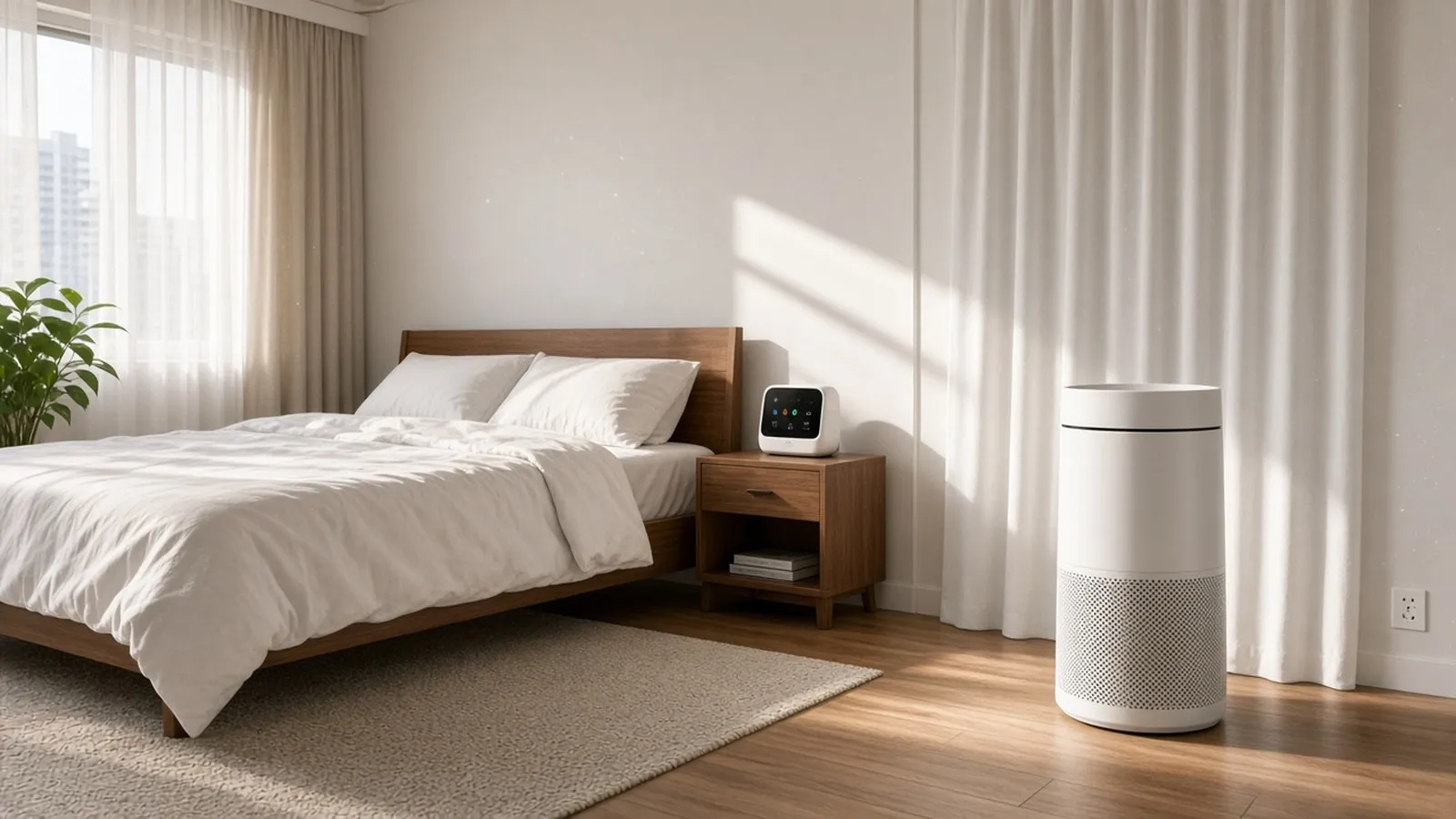
CADR stands for Clean Air Delivery Rate. It is the volume of particle-free air an air purifier delivers, measured in cubic meters per hour (m³/h) or cubic feet per minute (CFM). A higher CADR means the purifier cleans a room faster. Of all the numbers on a spec sheet, it is the one most directly tied to how quickly the air in your room gets clean.
If you only compare one number between two purifiers, make it CADR. Just make sure you know what it measures and what it leaves out.
What does CADR measure?
CADR combines two things into one figure:
- Airflow: how much air the fan moves through the filter.
- Filter efficiency: how much of the particles in that air the filter removes on a single pass.
A purifier that moves 200 m³/h of air through a filter that catches 90% of particles has a CADR of roughly 180 m³/h. A powerful fan with a weak filter scores poorly. So does an excellent filter behind a weak fan. CADR rewards the combination.
How is CADR tested?
The best-known method is the AHAM AC-1 standard from the Association of Home Appliance Manufacturers in the US. A purifier is placed in a sealed test chamber, particles are released, and the lab measures how fast concentrations fall with the purifier running compared with natural decay.
AHAM reports three separate CADR numbers, one for each particle type:
| Rating | Particle size | What it represents |
|---|---|---|
| Smoke | 0.09–1.0 µm | Fine particles, closest to PM2.5 from smoke and traffic |
| Dust | 0.5–3 µm | Household dust |
| Pollen | 5–11 µm | Larger allergen particles |
The smoke CADR is the most useful of the three for most shoppers. Fine particles are the hardest to capture and the most relevant to haze and PM2.5 pollution. Large pollen particles are easier to filter and also settle out of the air on their own, which is why pollen CADR is often the highest number on the box.
Outside the US, you will often see a single particle CADR in m³/h, usually tested under China’s GB/T 18801 standard with cigarette smoke. It is closest in spirit to the AHAM smoke rating.
CFM vs m³/h
The two units describe the same thing:
- 1 CFM ≈ 1.7 m³/h
- 1 m³/h ≈ 0.59 CFM
A purifier rated at 300 m³/h is roughly 177 CFM. Always convert before comparing a US-market spec sheet with an Asian or European one.
How to size an air purifier from CADR
The standard rule of thumb is to aim for about 4.8 air changes per hour (ACH). That means the purifier should be able to filter the room’s full volume of air nearly five times an hour. This is the basis of AHAM’s room-size recommendation. AirLab uses a slightly looser four air changes an hour (CADR ÷ 10 at a 2.5 m ceiling) on our spec tables.
The formula is simple:
Required CADR (m³/h) = room area (m²) × ceiling height (m) × 4.8
For a typical 2.5 m ceiling, that works out to 12 × room area in m². Or, working backwards:
Recommended room area (m²) = CADR (m³/h) ÷ 12
| CADR (m³/h) | CADR (CFM) | Recommended room at 2.5 m ceiling |
|---|---|---|
| 60 | 35 | 5 m² (desk or personal zone) |
| 120 | 71 | 10 m² |
| 180 | 106 | 15 m² |
| 300 | 177 | 25 m² |
| 450 | 265 | 38 m² |
If you have high ceilings, open-plan spaces, or you want faster cleanup during a smoke or haze event, size up. Running a bigger purifier on a quieter, slower speed is also usually more pleasant than running a small one flat out.
Be skeptical of room-size claims
Manufacturers often quote much larger room sizes than the 4.8 ACH rule supports. Many follow China’s GB/T 18801 rule, which allows as few as about three air changes per hour, and some homepage tiles go further still. That is enough to slowly maintain clean air in a sealed room, but not enough to recover quickly after cooking, incense, or outdoor haze gets in. That is why AirLab reviews list the manufacturer’s claimed room size next to our own CADR-based estimate.
What CADR means in real minutes
CADR also tells you roughly how long a cleanup takes. In a well-mixed room, particle levels fall exponentially:
Time (minutes) = 60 × room volume (m³) ÷ CADR (m³/h) × ln(starting level ÷ target level)
Take our standard test room: 9 m² with a 2.5 m ceiling, or 22.5 m³. Say PM2.5 needs to fall from 75 µg/m³ to 15 µg/m³.
- With a 180 m³/h purifier: about 12 minutes.
- With a 90 m³/h purifier: about 24 minutes.
That is the sealed-chamber math. In a real furnished room, expect it to take several times longer. In our furnished test room it is about five times longer, because furniture, corners, and uneven mixing slow things down. We build that into how we check listed CADR.
Halve the CADR and the cleanup time doubles. That linear relationship is why CADR matters more than filter marketing terms like “True HEPA” or “H13” on their own. Our guide to HEPA filter labels explains what those terms do and don’t tell you.
What CADR does not tell you
CADR is useful, but it is not the whole story:
- It is measured at the highest fan speed. Most people run a purifier on a slower speed because the top speed is too loud. Your everyday CADR may be a fraction of the rated number.
- It ignores noise. Two purifiers with the same CADR can differ by 10 dB or more. A purifier you switch off because it is annoying delivers zero clean air.
- It is measured with a fresh filter. Performance drops as the filter loads up, especially if you stretch replacement intervals.
- It covers particles only. A particle CADR says nothing about odors, gases, or VOCs. Activated carbon performance is a separate question.
- Lab chambers are not homes. Furniture, air leaks, open doors, and where you put the purifier all change the result.
- Not every CADR is independently verified. Some brands publish figures from their own labs, and test conditions vary between standards.
How AirLab uses CADR
We treat the listed CADR as a claim to check, not a result to repeat. Every review runs the same practical test in a furnished 9 m² room: we raise PM2.5 to at least 75 µg/m³ with incense, then time how long each fan speed takes to bring it down to 15 µg/m³.
From the listed CADR, we work out how long the cleanup should take in our room, allowing for the fact that a furnished room clears more slowly than a sealed chamber. Then we compare that with the time we measured on the top speed. If the purifier is no more than 15% slower, the claims check says the CADR matches our test. Room sizes in our reviews come from the CADR that held up, at about four air changes an hour. You can read the full formula and tolerances on our methodology page.
The bottom line
CADR is the fastest way to compare how much cleaning power a purifier actually has. Use the smoke CADR (or a single particle CADR in m³/h), aim for about 12 times your room’s floor area in m² at a standard ceiling height, and then check noise and running costs at the speed you will really use.
Ready to compare real numbers? Browse our air purifier reviews to see listed CADR, our measured result, and time-to-clean side by side.