
Best for
desks, travel, and a 1.2 m personal zone
Solid for desk, car, and bag use. Size, battery, and H11 filter match that job. We hold back from an 8+ because our 9 m² room test takes hours, not minutes.
Our verdict
If you want cleaner air next to your laptop, in the car, or in a bag, the Smart Air QT3 is an easy yes. It is small (0.72 kg), runs on a USB-C battery, and uses a real H11 HEPA filter for dust and smoke particles near your face. It is not meant to clean a whole bedroom overnight. It is built for about a 1.2 m personal zone, not a full room. AirLab score: 7.0 / 10.
Smart Air makes straightforward filter purifiers. Air goes through a HEPA sheet that traps fine dust and smoke, with no ionizer spraying charged particles into the room. In Thailand they are sold by WEDO AIR, from this little portable QT3 up to room models like The Sqair and SA600.
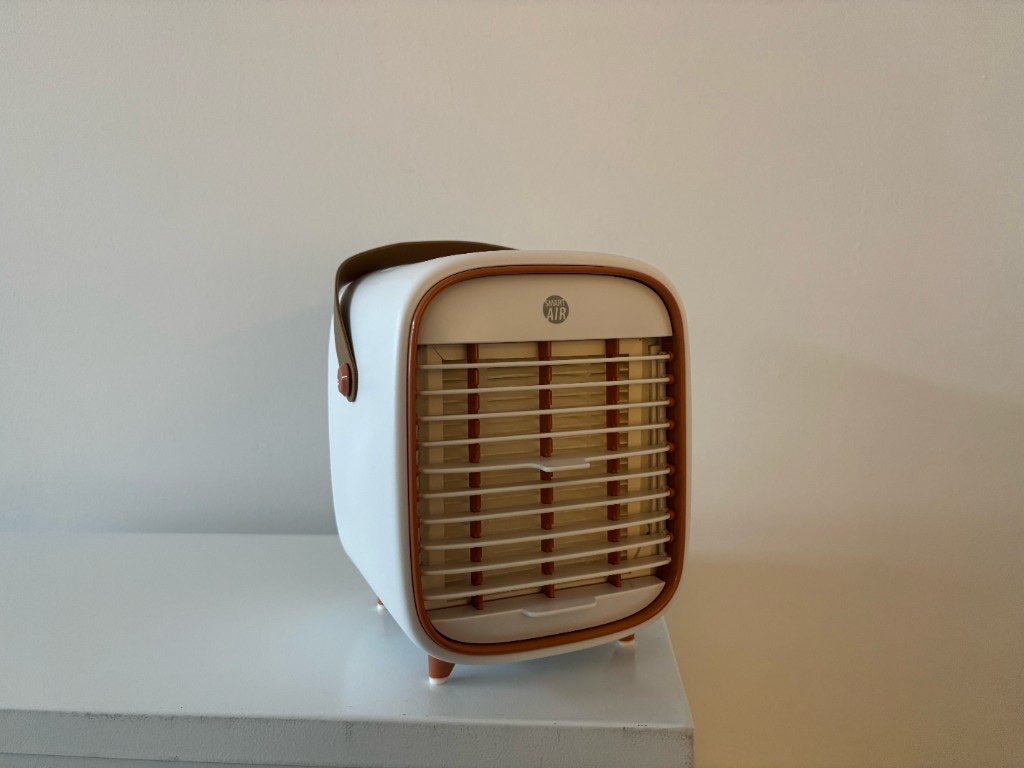
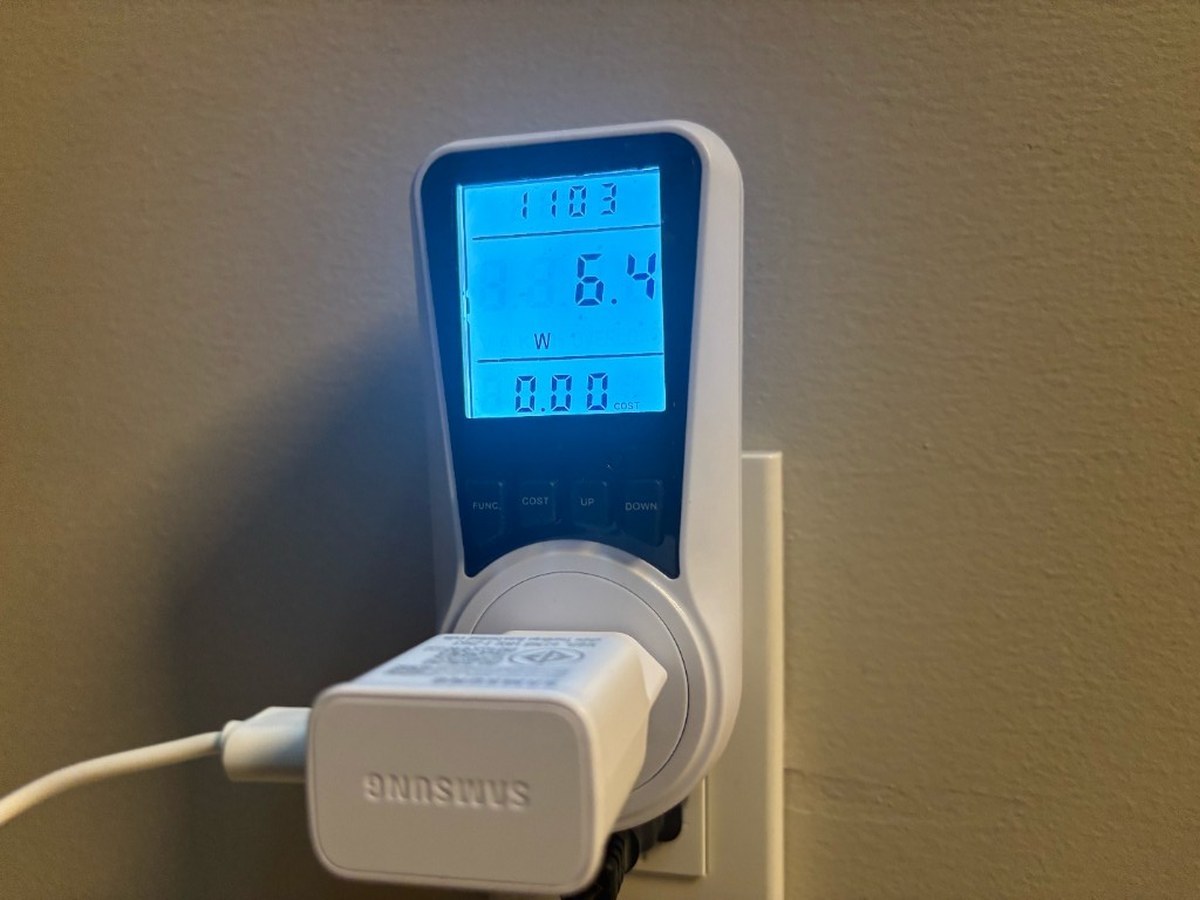
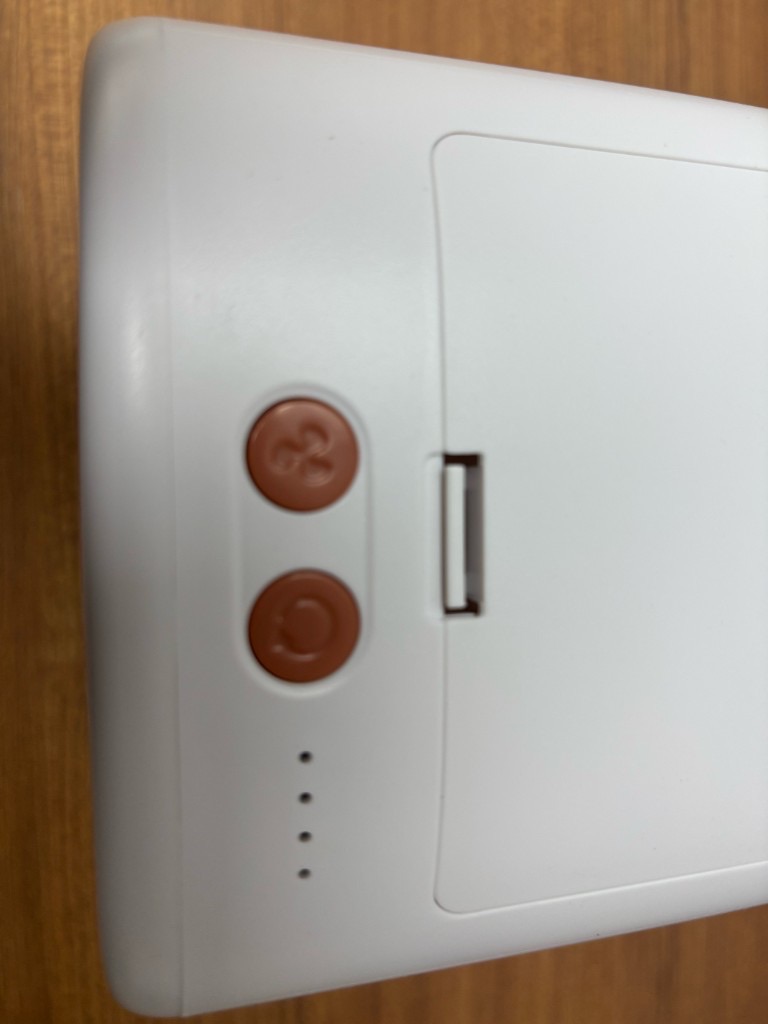
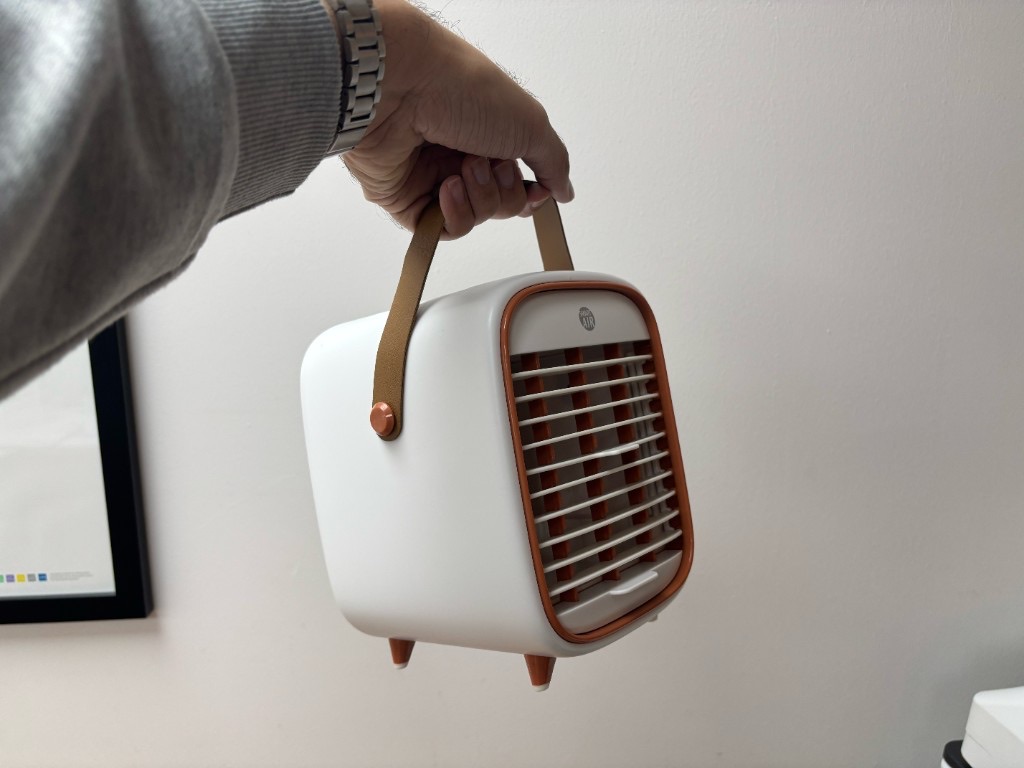
Think of the QT3 as a personal companion, not furniture for the corner. It weighs 0.72 kg, is about 15 × 14.5 × 18 cm, and has a leather-look handle so it is easy to move. USB-C charging and a 2,000 mAh battery give roughly 4 hours on speed 1, 3 on speed 2, and 2 on speed 3. Two copper top buttons set the fan. Our wall meter read 1.7 W on speed 1, 2.3 W on speed 2, and 6.4 W on speed 3. On speed 1 it reads about 35.8 dB(A) at 1 m; on speed 3 about 40.6 dB(A).
WEDO AIR lists clean-air output (CADR, how much cleaned air comes out) at 37 m³/h with an H11 HEPA filter. That output fits air near your face, not overnight cleaning of a full bedroom. In our standard 9 m² room test, speed 3 took 291.4 minutes to bring PM2.5 from 75 down to 15 µg/m³.
What is in the box?
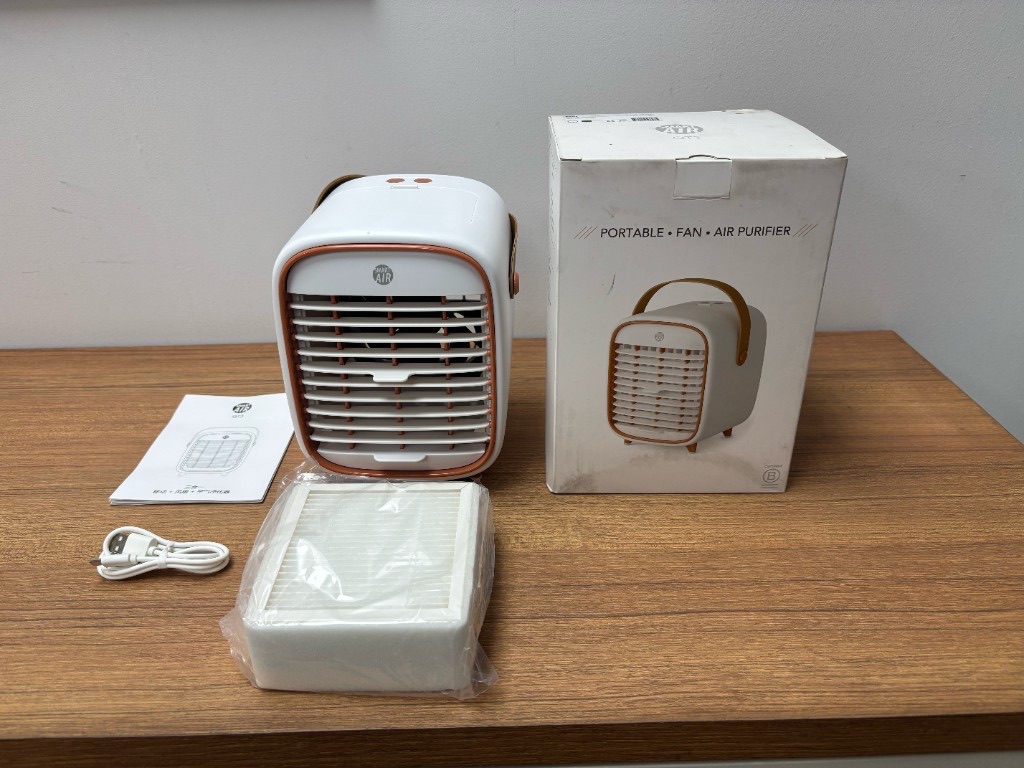
Open the box and you get a complete starter kit: the unit, a filter already ready to use, a USB charge cable, and a short manual. No wall brick is included; any USB power source that can feed the QT3 will do.
- Smart Air QT3 portable purifier
- H11 HEPA filter cartridge
- USB charging cable (USB-C on the unit)
- Quick-start / user manual
How do we test the QT3?
We test every air purifier the same way so you can compare results from one review to the next. For the QT3 we used our usual 9 square meter room with a 2.5 meter ceiling. That is much bigger than the small personal zone the QT3 is built for, and that is intentional. We want to see how the unit behaves when the job is harder than a desk bubble. We light incense sticks to fill the air with fine particles. When our Temtop S1 monitor shows PM2.5 at 75 micrograms per cubic meter, we take the incense out, turn the unit on, and stop the timer when that reading first falls to 15 or below. We fill the room with smoke again before each speed. The photos below show this QT3 run. If you want every rule in one place, including where we put the monitor and how we measure noise and power, read the full method on our methodology page.
Step 1: We light incense sticks
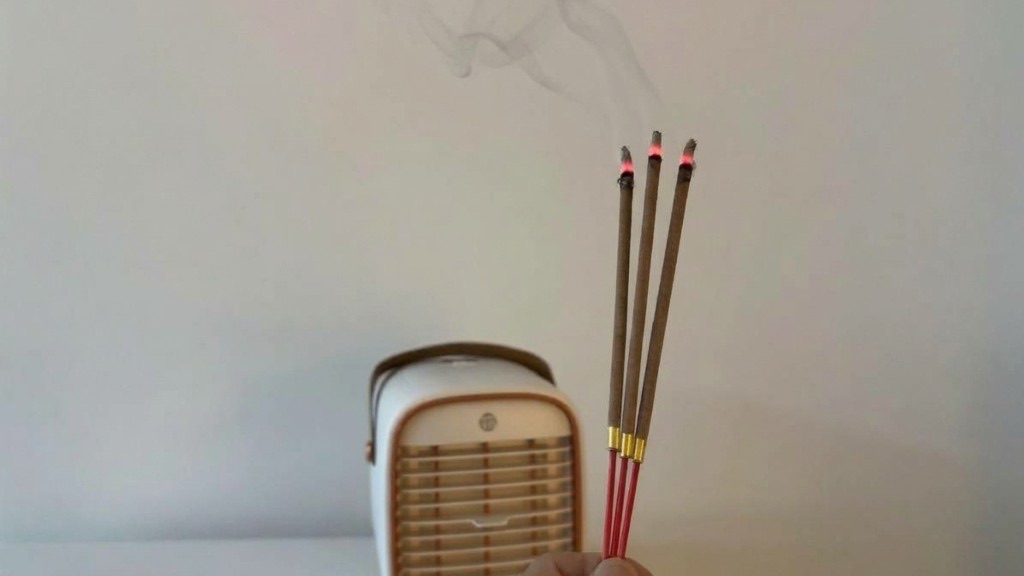
First we light incense sticks so the room fills with fine particles and smoke. The doors stay closed and the air conditioning stays off, so the smoke comes from the incense and not from open windows or the street. When the Temtop S1 reads 75 µg/m³, we take the incense out of the room.
Step 2: We place the QT3 and the air monitor
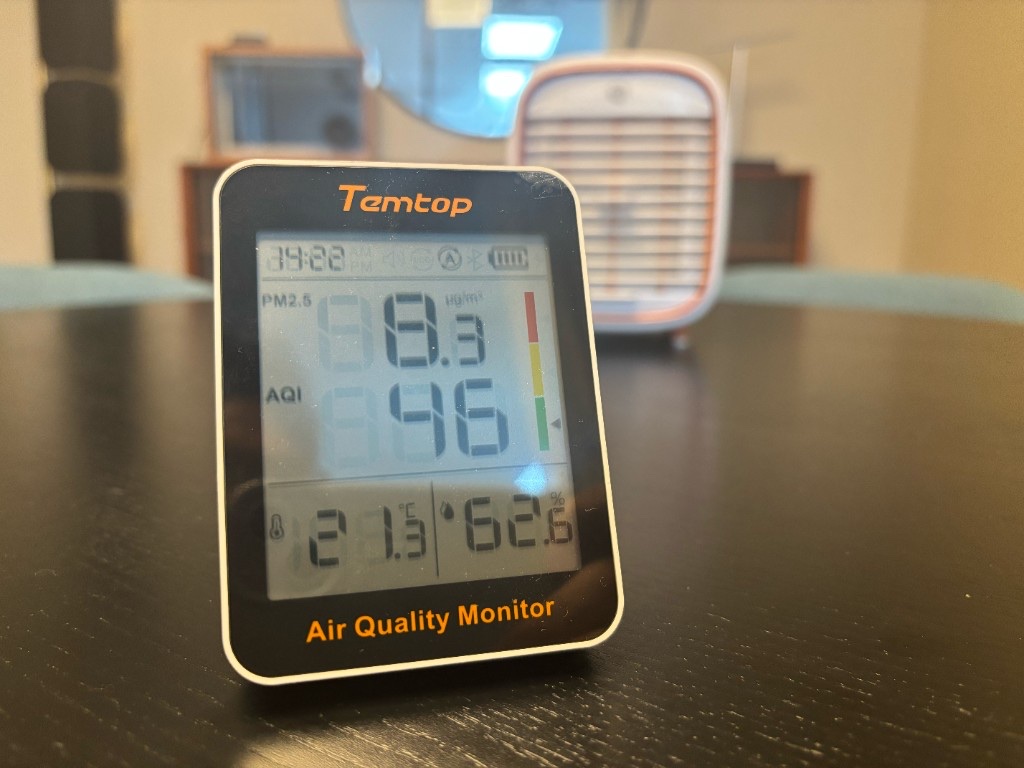
We set the QT3 on the table where someone might actually use it. The Temtop S1 sits nearby and keeps logging PM2.5. We do not start the cleaning timer until that reading reaches at least 75 micrograms per cubic meter.
Step 3: We run every speed and time the cleanup
When the start level is reached, we switch the QT3 to the speed we are testing and start a timer. We stop the timer as soon as the monitor first shows PM2.5 at 15 micrograms per cubic meter or lower. We do a separate run on speeds 3, 2, and 1, each one starting again from at least 75, so every speed gets its own cleanup time in minutes.
Step 4: We check how much electricity it uses
After the particle run, we plug the QT3 into a wall energy meter through its USB charger. We write down the watt reading on speeds 1, 2, and 3 so we can estimate the yearly electricity cost later in this review.
Step 5: We check how loud each speed is
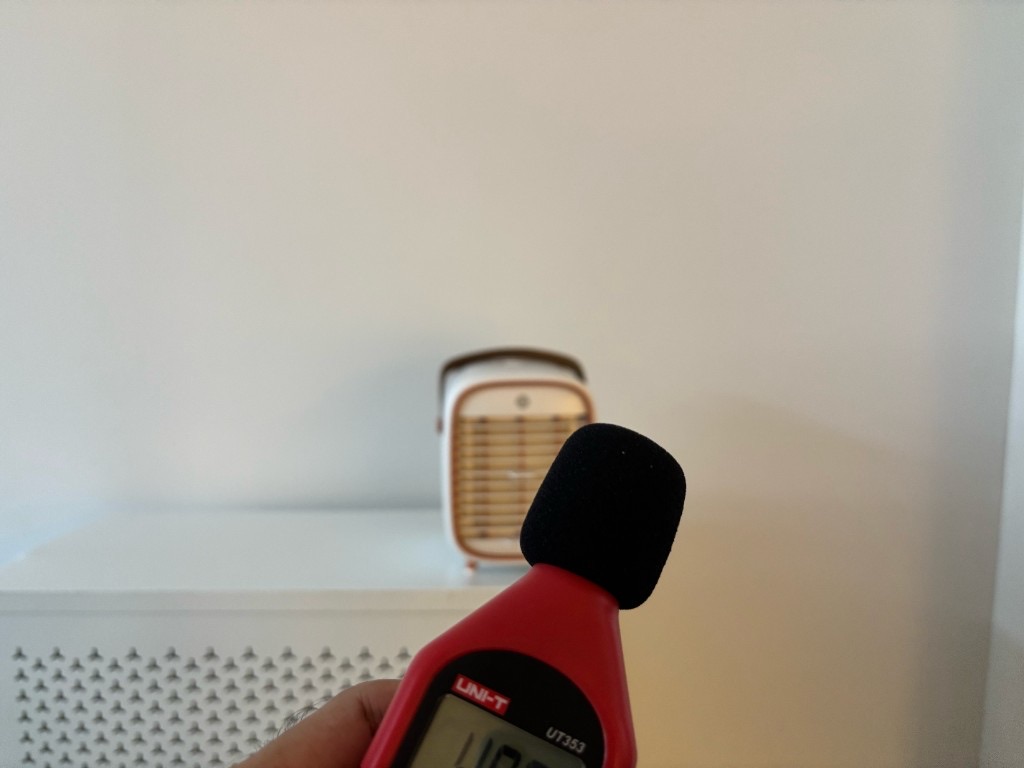
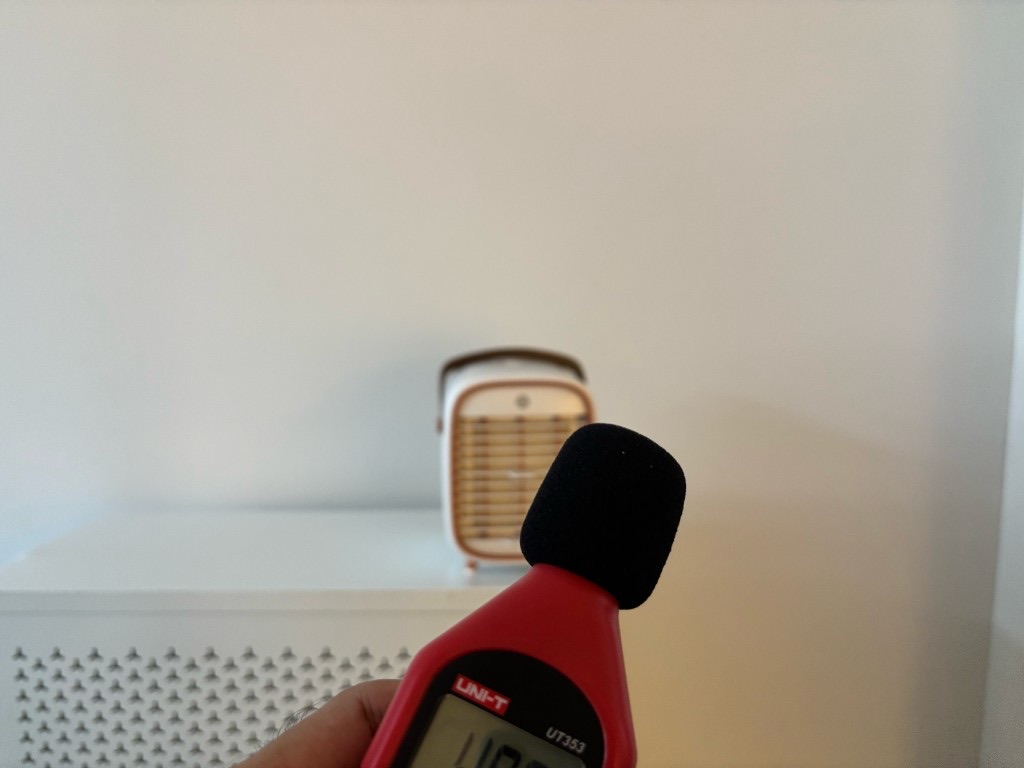
Last we measure sound with a handheld meter held 1 meter from the unit. We do this for every fan speed. That same distance is used on every AirLab review so the noise numbers stay comparable.
Full protocol (gates, placement, noise, power, scoring): the AirLab methodology.
How well does the QT3 clean the air?
We ran the QT3 through our standard incense particle test in the closed 9 m² lab room (2.5 m ceiling). We lit incense sticks until the Temtop S1 read 75 µg/m³, took the incense out of the room, and switched the purifier on. We stopped the clock at the first moment PM2.5 fell to 15 µg/m³ or below, then filled the room with smoke again before testing the next speed. That is the same start and clean gate we use on every AirLab review, so you can compare one unit to the next.
Time to clean air
From this run, here is how long each fan speed took to bring PM2.5 from 75 down to 15 µg/m³.
- Speed 3
- 291.4min
- Speed 2
- 407.9min
- Speed 1
- 611.8min
Start 75 → clean ≤ 15 µg/m³ · Incense out before fan on · Room refilled for each speed
Particle removal test
Smart Air QT3
- Speed 3291.4 min
- Speed 2407.9 min
- Speed 1611.8 min
Full protocol on the methodology page.
What stands out about the QT3, and what does not?
Strengths
- Truly portable at 0.72 kg, with a handle, USB-C charging, and a 2,000 mAh battery
- Does what it claims for air near your face, and is honest about not being a whole-room machine
- Real HEPA filter (H11), not an ionizer, with TIS and CE marks listed
- Quiet at a desk (35.8–40.6 dB at 1 m) and only 1.7–6.4 W, so power use stays very low
Limitations
- Clean-air output is personal-size. A bedroom or studio needs a stronger unit
- No carbon filter stage for cooking, smoke, or traffic smells
- Replacement filters come in a 2-pack; the 1-year warranty does not cover filters
- Battery life is a few hours on speed 3, so all-day desk use usually means staying plugged in
How is the QT3 designed, and how easy is it to use?
The QT3 is about the size of a small speaker. It is meant to sit next to you, not against a far wall.
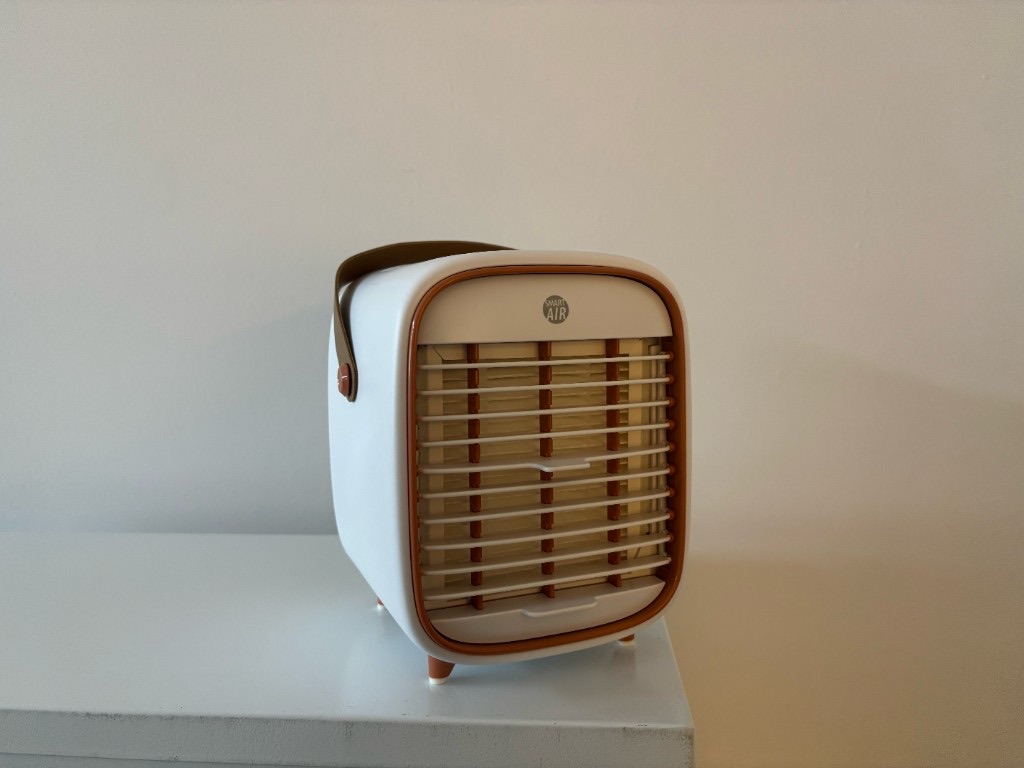
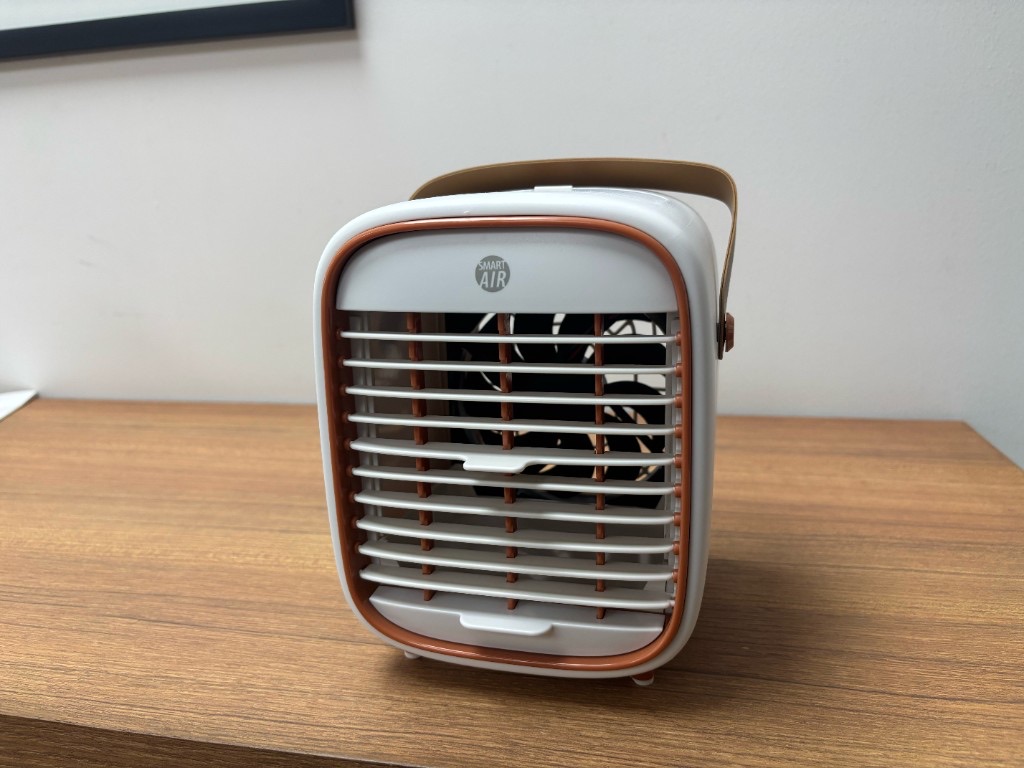
The shell is hard white plastic with a glossy finish. It is light enough for a bag, easy to wipe, and quick to show fingerprints. The carry strap looks like leather with copper-tone rivets. The front grille sits in a copper-bronze frame. WEDO AIR does not name the exact plastic type; in hand it is a normal consumer plastic cube with decorative trim.
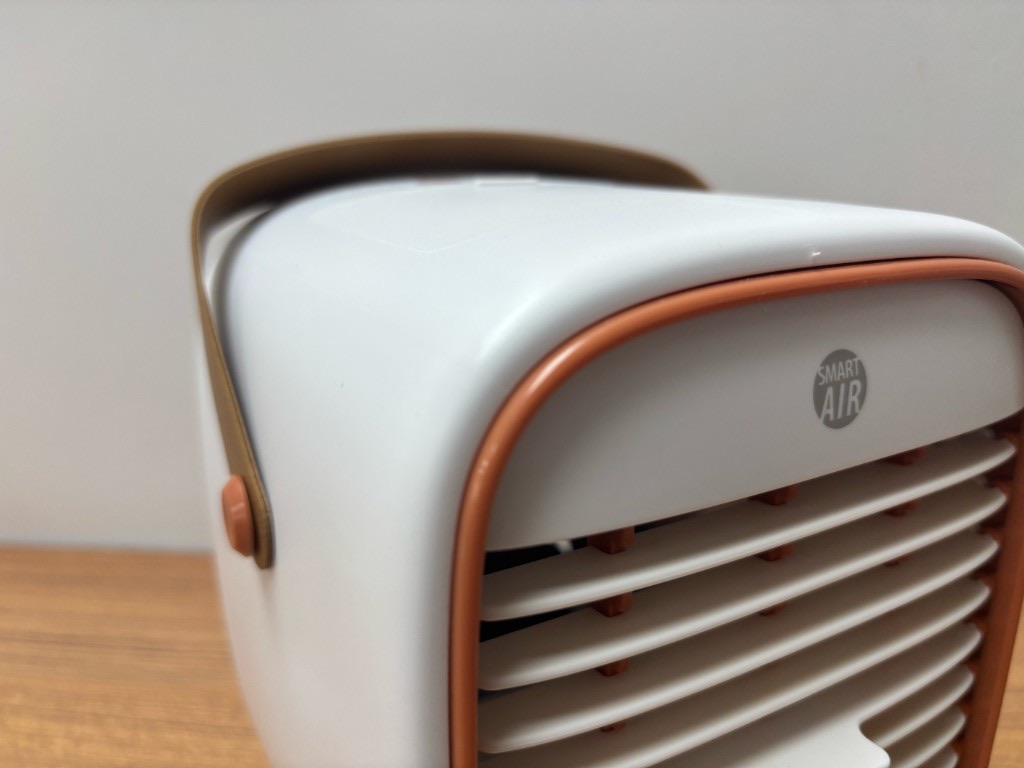
WEDO AIR shows it for commuting, a cafe table, a desk, a nightstand, or a car. That matches how strong the clean-air output is. About 1.2 m of useful reach is a personal zone. If you park it in the corner of a 40 m² room, you bought the wrong Smart Air model.
Controls are two copper buttons on top (a circle control and a fan-speed button) with four tiny LED dots beside them, not an app. For a travel unit that is a plus. There is no Auto mode and no built-in air-quality sensor to get wrong. The story stays simple.
The 2,000 mAh battery is rated about 4 hours on speed 1, 3 on speed 2, and 2 on speed 3, with roughly 3 hours to recharge over USB. The idea is simple: carry it, charge it, keep it about a meter from your face. We use the 0.72 kg shipping weight; another table on the page says 1 kg, which is another listing conflict.
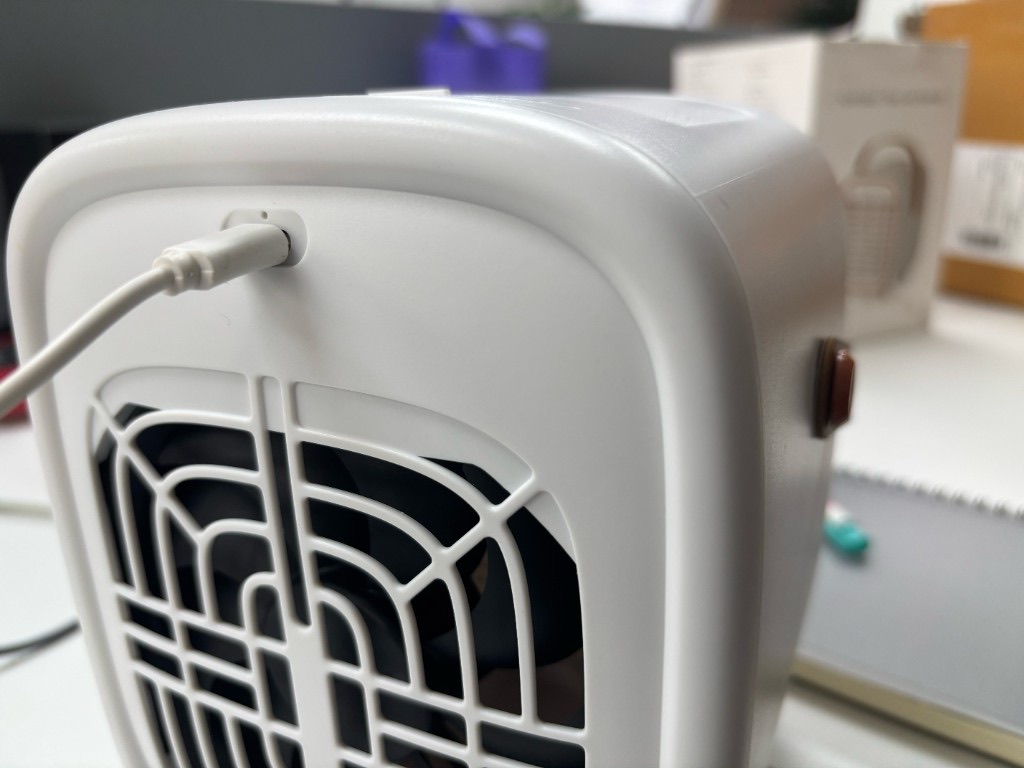
We also ran a battery drain test on speed 3. Fully charged, USB unplugged, fan locked on speed 3 until the unit shut off. Our stopwatch landed at 2.32 hours, a little over the listing’s ~2 hour speed 3 claim, and enough for a commute or a stretch at a cafe table without hunting for an outlet.
What does the QT3 filter actually capture?
This filter is for particles: dust, smoke bits, and pollen.
The listing uses an H11 HEPA filter with “over 95%” particle removal on one pass. HEPA grades tell you how fine a filter is: H11 is solid for many consumer units; H13 (often called True HEPA) is tighter, often about 99.97% at 0.3 microns. For this review we treat the QT3 as H11, as written in the main specs.
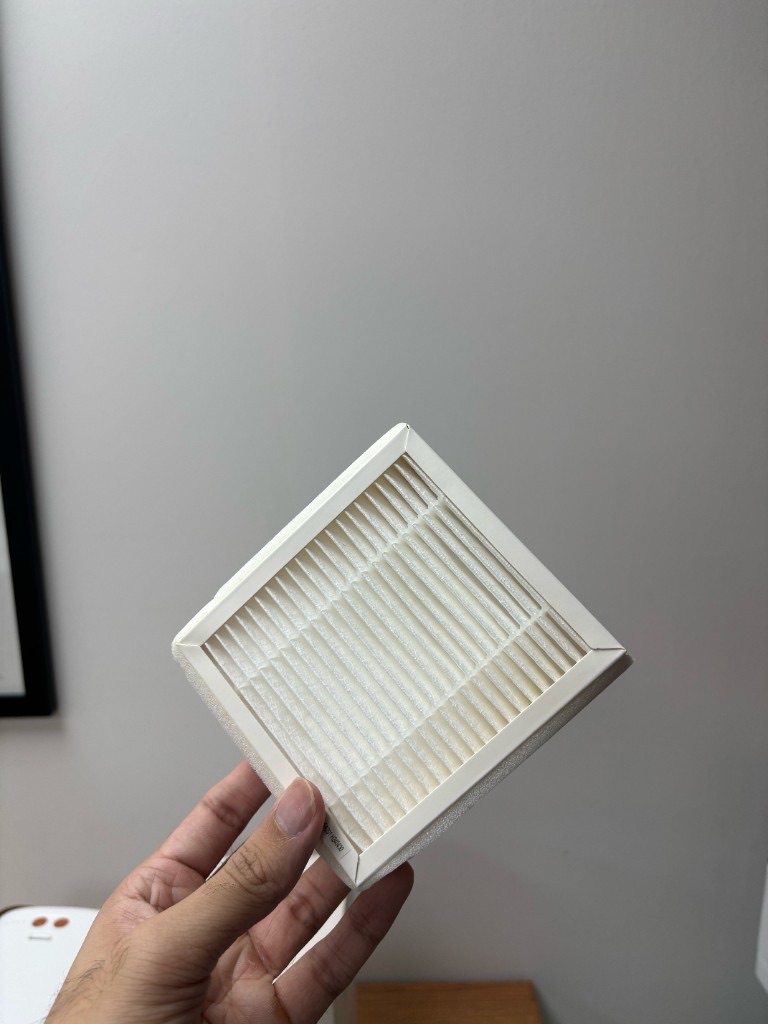
WEDO AIR says the filter helps with PM2.5 (fine particles), dust, pollen, pet hair, and mold spores. It also mentions bacteria and viruses. We do not treat those last claims as medical results. A good particle filter can catch tiny bits in the air. That is not the same as treating an infection.
Filter life is listed as up to 800 hours (about 200 days at 8 hours a day on one page, and 200 days at 4 hours a day on another). The replacement pack repeats 800 hours and also says “3 months.” Trust hours of use, not the calendar slogan.
How often do you replace the QT3 filter?
Official replacements are a 2-pack of H11 HEPA filter cartridges at ฿790 on WEDO AIR. Filters are not covered by the 1-year unit warranty. If you skip changes, clean-air output drops and the fan works harder for less result.
- Schedule
- Up to 800 hours.
- Filter price
- ฿790 for a 2-pack
- Annual cost
- About ฿1,580 / year if you swap about every 3 months (2 packs)
How you change it
Turn the unit off, pull the front grille panel straight off (the copper-framed face comes away as one piece), lift the white HEPA block out of the tray on the back of that panel, drop in the new filter the same way, and slide the front assembly back on until it clicks. No tools. Bag the used filter so it does not shed dust on the desk.
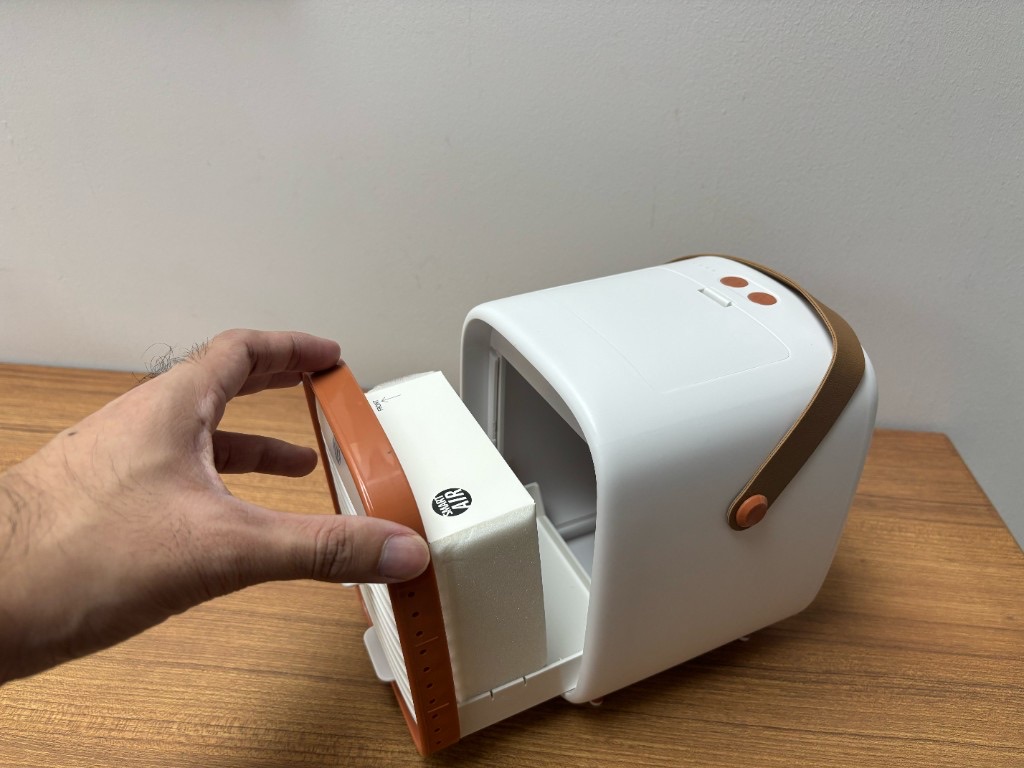
The pack includes two H11 HEPA filters. Confirm the live price before you buy. QT3 HEPA Filter at WEDO AIR.
How loud is the QT3?
Speeds 1 / 2 / 3: 35.8 / 38.2 / 40.6 dB(A), measured at 1 m from the QT3 (AirLab standard for every unit). Our empty room reads about 20 dB(A), so that gap is the purifier itself. All three speeds stay soft enough for a desk; speed 1 is the one you want on a call.
- Speed 136dB(A)
- Speed 238dB(A)
- Speed 341dB(A)
Measured 1 m from the unit at 1.2 m height, A-weighted. Reference markers are everyday comparisons, not test results.
What does the QT3 cost to run?
Running the Smart Air QT3 will cost about ฿1,666 per year for electricity plus filter replacements, about ฿139 per month. That is what you keep paying after you own the box. The unit itself is a one-time buy.
Annual running cost split
฿1,666 / year
- Electricity
- ฿86
- Filters
- ฿1,580
1. Electricity = ฿86 per year
Our wall meter through the USB charger read 1.7 W on speed 1, 2.3 W on speed 2, and 6.4 W on speed 3, well under the listing’s 9 W. For the yearly electricity line we assume desk use at 8 hours a day on speed 3, at ฿4.5 per unit of electricity (kWh). That fits a workday desk habit better than leaving a bedroom cube on around the clock.
- Speed 11.7W
- Speed 22.3W
- Speed 36.4W
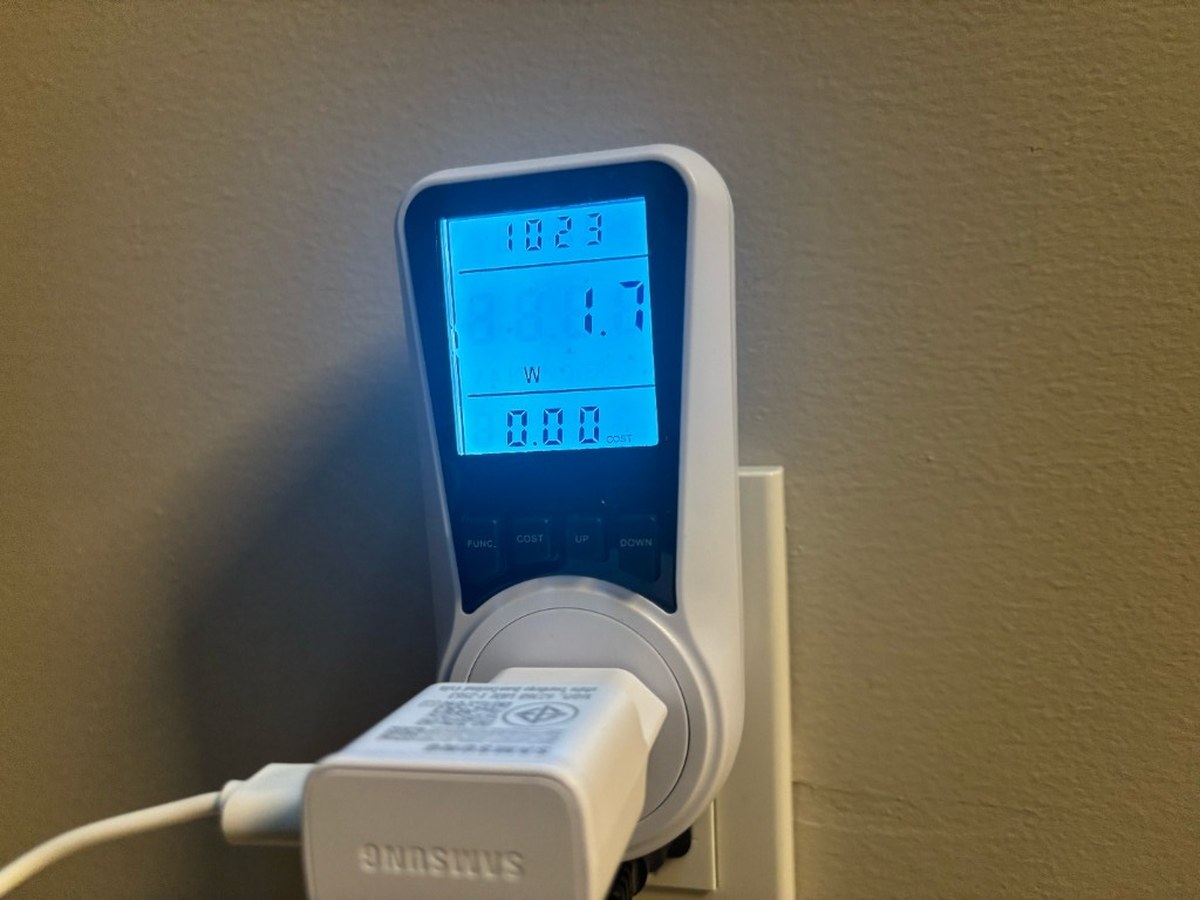
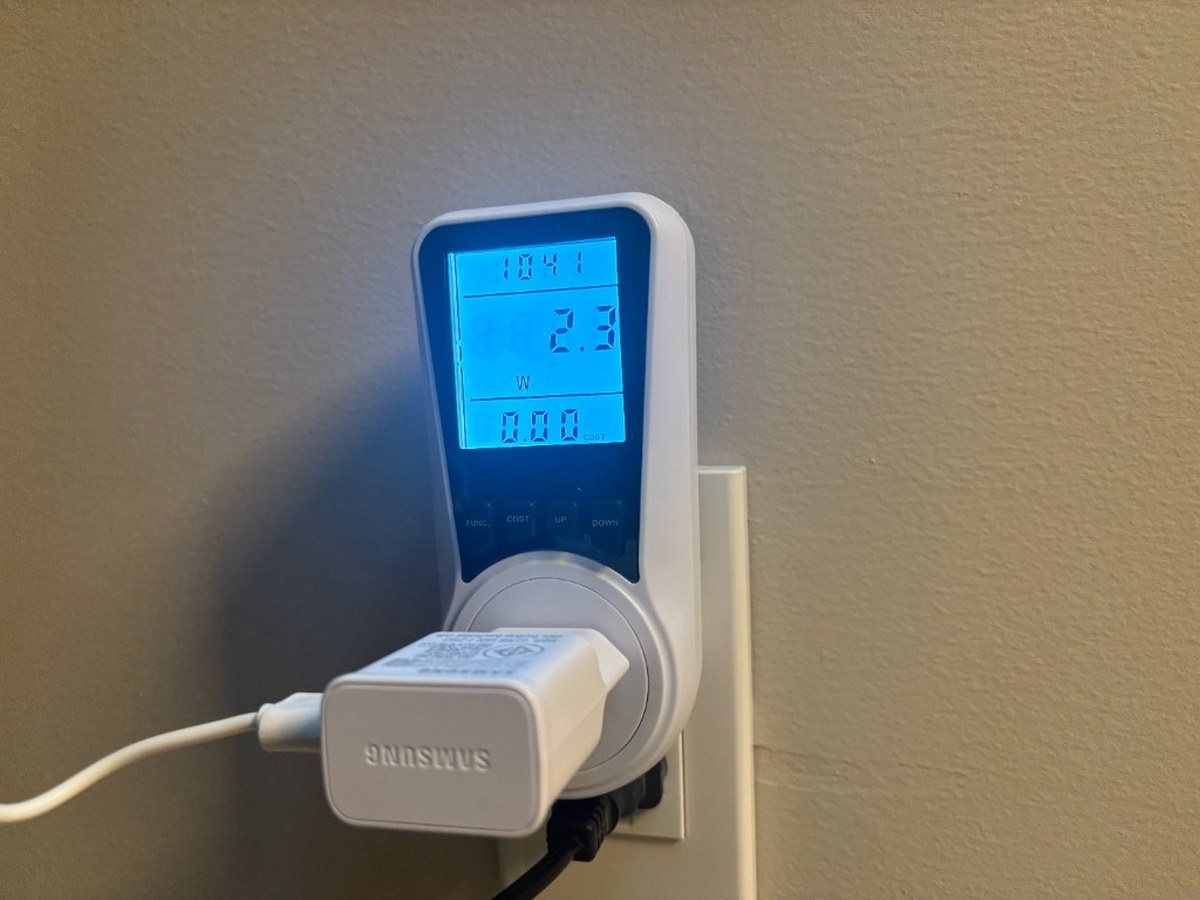
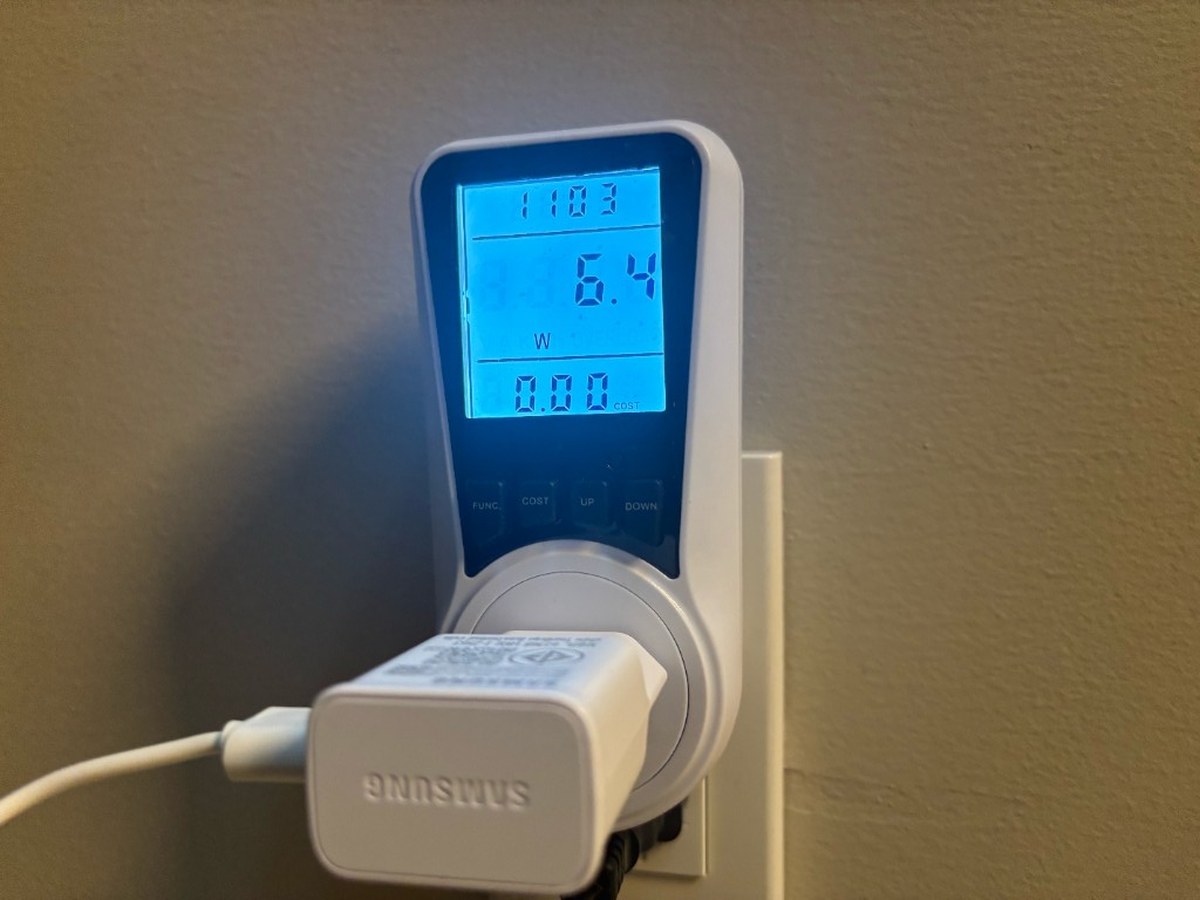
6.4 W × 8 h/day × 365 ÷ 1000 = 19 kWh × ฿4.5/kWh = ฿86
2. Filter costs = ฿1,580 per year
HEPA filter cartridges fill up with particles and need replacing. Official QT3 filters are a 2-pack of H11 cartridges for ฿790 on WEDO AIR, rated up to 800 hours each. At about 8 hours a day you use roughly 2,900 hours a year, about two 2-packs, or ฿1,580. Filters are the big ongoing cost. Electricity is not.
฿790 × 2 packs · 800 h rated life per cartridge
3. Product price = ฿1,490 once
WEDO AIR listed the QT3 at ฿1,490 when we checked. Add that once in year one. After that you are mostly paying for filter packs.
- Annual running cost
- ฿1,666 / year · ฿139 / month
- First-year total
- ฿3,156 (unit + running)
- Est. per month (year 1)
- ฿263 / month
Totals
Who should buy the QT3?
The QT3 is a good fit when you want cleaner air you can carry and keep near your face. It is a mismatch if you are shopping for a whole-room cleaner, a medical device, or a larger HEPA cube for overnight use.
Best-fit scenarios
- A desk, nightstand, or car seat where the grille can sit within about 1.2 m of your face
- Travel and commuting when a 2,000 mAh battery and USB-C matter more than cleaning a full room
- Shoppers who want a real HEPA filter (not an ionizer) in a small TIS- and CE-marked shell
Skip it if
- You need solid overnight cleaning in a bedroom, studio, or open plan. Look at The Sqair or a larger Smart Air unit
- Odors, cooking fumes, or wildfire gases are the main job
Related picks
- Smart Air Sqair review for a quiet bedroom unit up to about 30 m².
- Smart Air SA600 review for living rooms and large bedrooms up to about 45 m².
What are the key QT3 specs and test data?
Brand figures come from the WEDO AIR listing. Measured figures are from our own tests. A dash means we did not measure it.
Product
- Clean air output (CADR)
- Brand37 m³/h (top speed)
- Measured—
- Filter
- BrandH11 HEPA particle filter
- Measured—
- Size / weight
- Brand15 × 14.5 × 18 cm · 0.72 kg
- Measured—
- Warranty
- Brand1-year unit warranty (filters excluded)
- Measured—
Room size
- Recommended room
- Brand10 m²
- Measured4 m² (about 4 air changes an hour)
Time to clean (9 m² room, PM2.5 75 → 15 µg/m³)
- Speed 3
- BrandNot listed
- Measured291.4 min
- Speed 2
- BrandNot listed
- Measured407.9 min
- Speed 1
- BrandNot listed
- Measured611.8 min
Battery
- Capacity
- Brand2,000 mAh
- Measured—
- Runtime · Speed 1
- BrandAbout 4 h
- Measured—
- Runtime · Speed 2
- BrandAbout 3 h
- Measured—
- Runtime · Speed 3
- BrandAbout 2 h
- Measured2.32 h
- Charge
- BrandUSB-C · About 3 h
- Measured—
Noise (dB(A), our meter at 1 m)
- Speed 1
- Brand29 dB
- Measured35.8 dB(A)
- Speed 2
- Brand34 dB
- Measured38.2 dB(A)
- Speed 3
- Brand45 dB
- Measured40.6 dB(A)
Power (watts at the wall)
- Speed 1
- Brand9 W
- Measured1.7 W
- Speed 2
- Brand9 W
- Measured2.3 W
- Speed 3
- Brand9 W
- Measured6.4 W
- Annual energy
- BrandNot listed
- Measured19 kWh · ฿86 / year
How do the QT3’s listed claims compare to our tests?
Here is what the WEDO AIR / Smart Air listing says next to what we measured in our room. Brands test in sealed lab chambers and we test in a furnished room, so small gaps are normal. We only say a claim falls short when the gap would change which purifier you should buy. The full rules are on our methodology page.
What the brand says
Clean air output (CADR) 37 m³/h
Different standardWhat we found
The QT3 is a personal purifier, so we do not judge its CADR against a whole room. 37 m³/h is the right size for the air within about 1.2 m of you, which is how WEDO AIR shows it being used.
What it means for you
Keep it on your desk, nightstand, or car seat, pointed at you.
What the brand says
H11 HEPA particle filter
Matches our testWhat we found
The unit uses a real H11 HEPA cartridge. The filter job matches particle cleanup near your face.
What the brand says
Clean air in about a 1.2 m personal zone
Matches our testWhat we found
Size, airflow, and how we used it on a desk match a personal bubble, not a whole room. Our 9 m² incense test took hours, which fits a personal-zone machine.
What the brand says
Useful for rooms up to about 10 m²
Falls short of claimWhat we found
At 37 m³/h, a 10 m² room gets about one and a half air changes an hour, well past even the Chinese GB/T 18801 sizing rule (about 4 m² for this CADR). In our 9 m² incense test, speed 3 took 291.4 minutes to reach clean.
What it means for you
For a whole bedroom, pick the Sqair. The QT3 is for the air right around you.
What the brand says
Noise about 29 / 34 / 45 dB(A)
CloseWhat we found
Our meter at 1 m measured 35.8 / 38.2 / 40.6 dB(A) on speeds 1 / 2 / 3. Speeds 1 and 2 run louder than listed; speed 3 is a bit quieter than listed. All three stay desk-friendly.
What the brand says
About 9 W power draw
Matches our testWhat we found
The wall meter on the USB charger reads 1.7 / 2.3 / 6.4 W on speeds 1 / 2 / 3, well under the listing.
What the brand says
Battery about 2 hours on speed 3 (listing also ~4 h on speed 1 / 3 h on speed 2)
Matches our testWhat we found
Our battery run on speed 3 lasted 2.32 hours, which meets the ~2 hour speed 3 claim.
What the brand says
Portable for travel, car, and desk
Matches our testWhat we found
At 0.72 kg with a handle and USB-C charging, it moves easily between desk, bag, and car seat.
How did we score the QT3?
The 7.0 overall score is the average of these category scores. Each one is scored for what the QT3 is meant to do (a personal clean-air zone), not as if it were a bedroom cube.
- Strongest
- Convenience and ease of use10/10
- Weakest
- Features and functions2/10
Air purification
5 / 10
Strong enough for air near your face on a desk or in a car. In our 9 m² room it took 291 minutes on speed 3. That is why this is not a 7 or higher.
Maintenance and cleaning
9 / 10
Front grille pulls off, HEPA drops out of the tray, new filter clicks back in. No tools, no fuss.
Features and functions
2 / 10
Power, three fan speeds, and LEDs. No sensor, no auto mode, no app, no carbon stage. Intentionally simple, and thin on extras.
Design and looks
8 / 10
Compact white cube with a leather-look handle and copper accents. Looks considered for the size, without pretending to be furniture.
Material quality
7 / 10
Hard consumer plastic with decorative trim. Fine for a portable unit; not premium metal or solid wood.
Convenience and ease of use
10 / 10
Two top buttons, USB-C charge, light enough to move with one hand. Setup takes minutes.
Value for the price
8 / 10
Around ฿1,490 for a real H11 HEPA personal unit with battery. Fair if you want portability; a waste if you expected a room cleaner at this price.
Overall satisfaction
7 / 10
Happy buy for desk, car, and bag shoppers. Frustrating if you bought it for a bedroom. Match the job and the score holds up.
Bottom line
For a desk, car seat, or travel bag, the QT3 is a friendly little personal purifier with a handle, battery, real H11 filter, and clean air near your face. For a bedroom or studio, spend the money on a room unit that moves several hundred cubic meters of clean air per hour instead. Match the machine to the job and you will be happy either way.
Ready to buy?
Smart Air QT3
Listed at ฿1,490 on WEDO AIR when we checked.
View QT3 at WEDO AIRAffiliate disclosure: If you buy through this link, AirLab may earn a commission. That commission does not change our score, ranking, or verdict. Read the editorial policy.
Supporting resources:How we testAll reviewsEditorial policy